Prospective
students:
If you are interested in post-graduate study
under my supervision, feel welcome to contact me
to discuss possibilities. Please refer to the
examples of topics below.
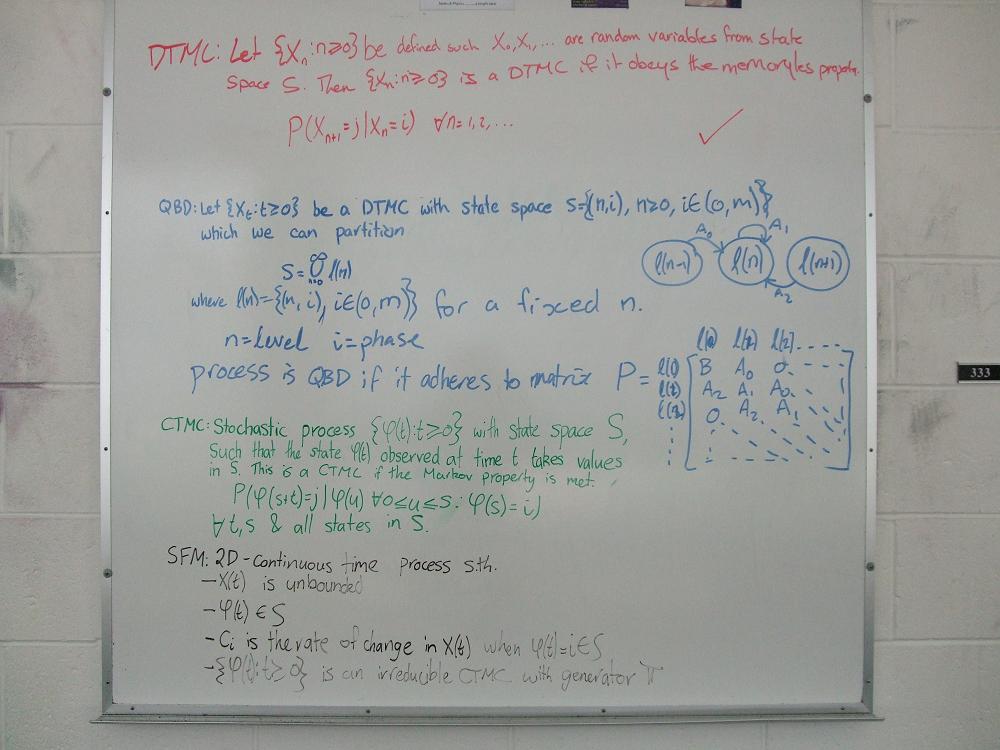
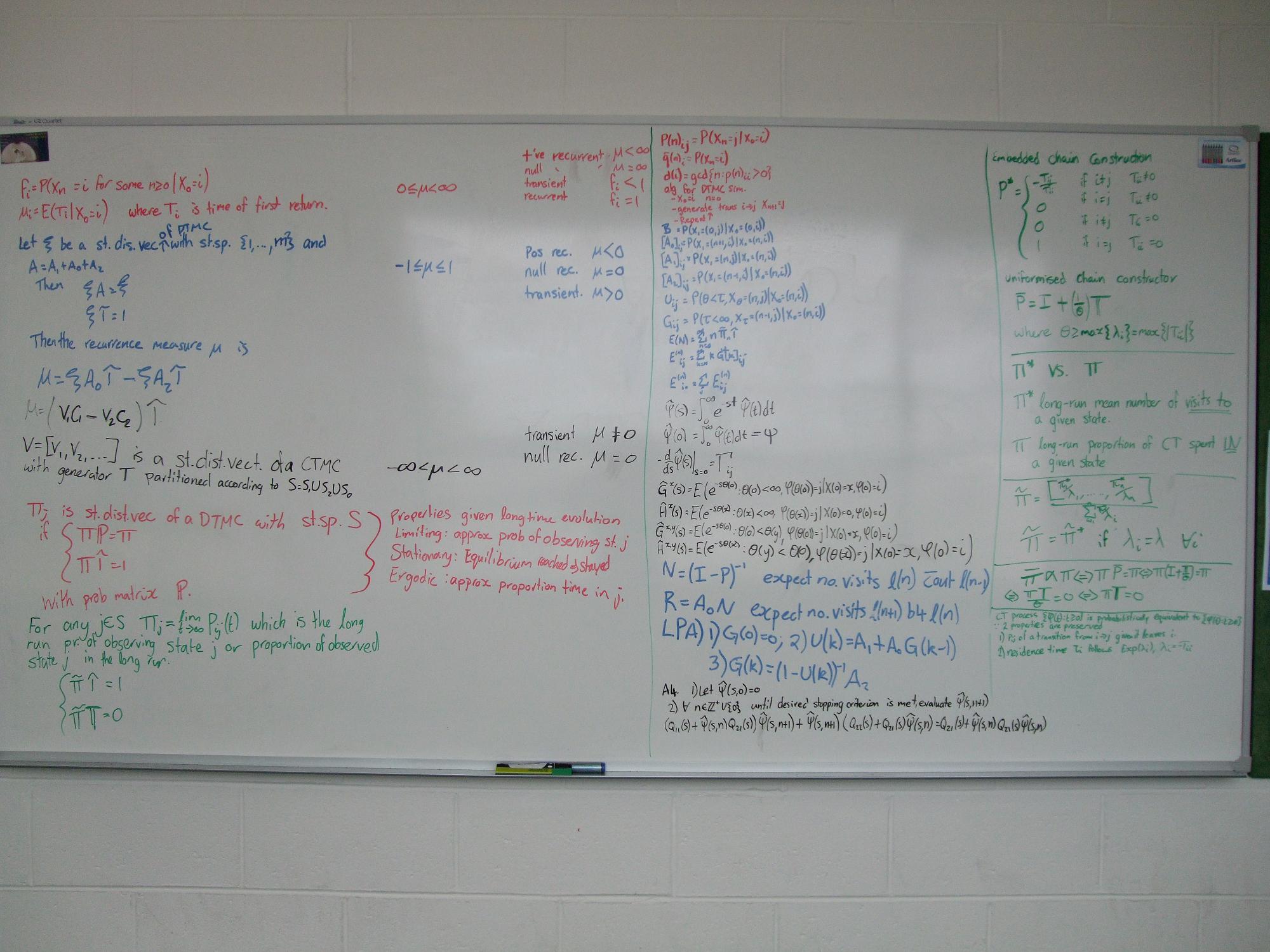
Matrix-analytic methods:
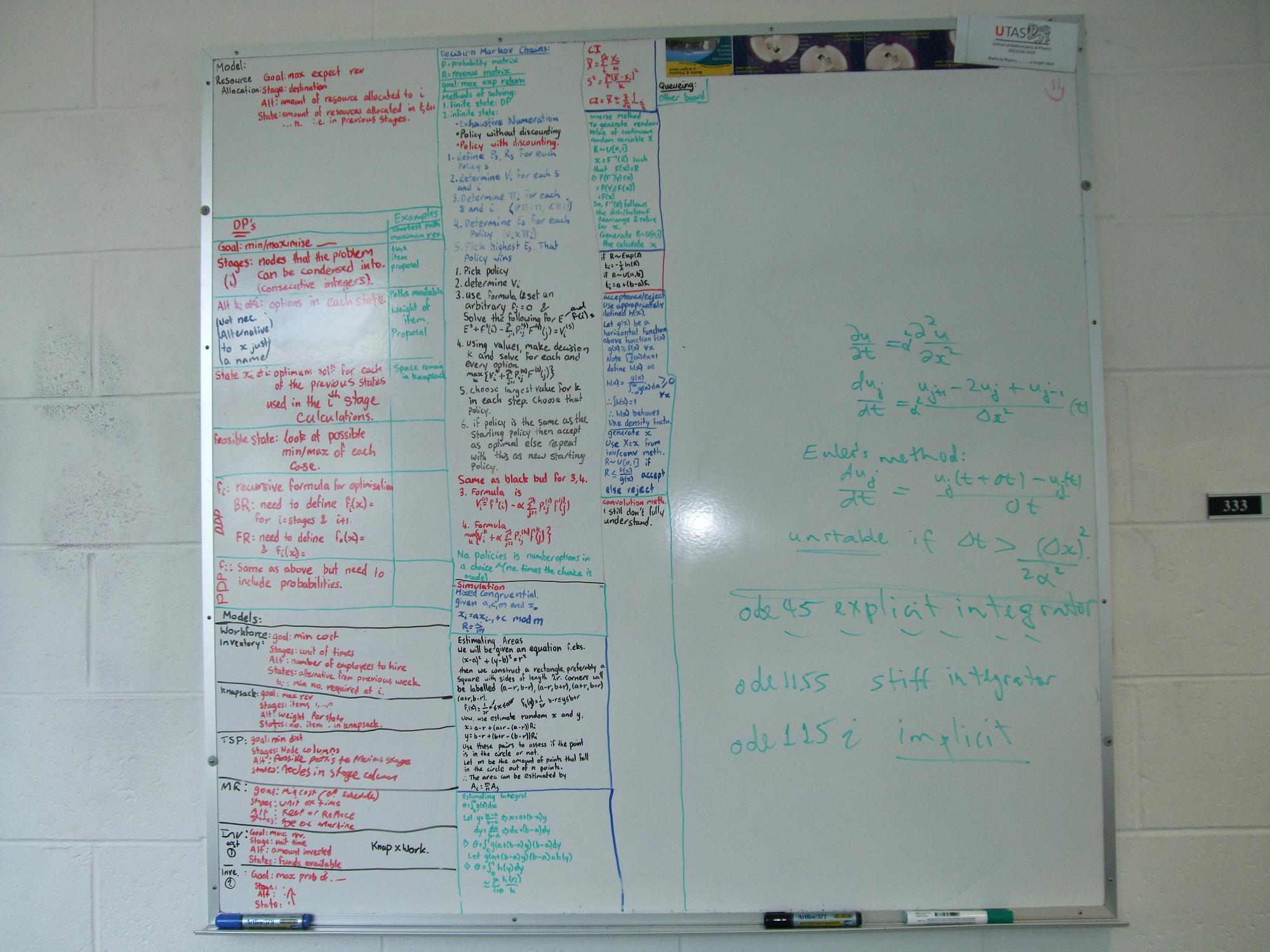
Operations Research:
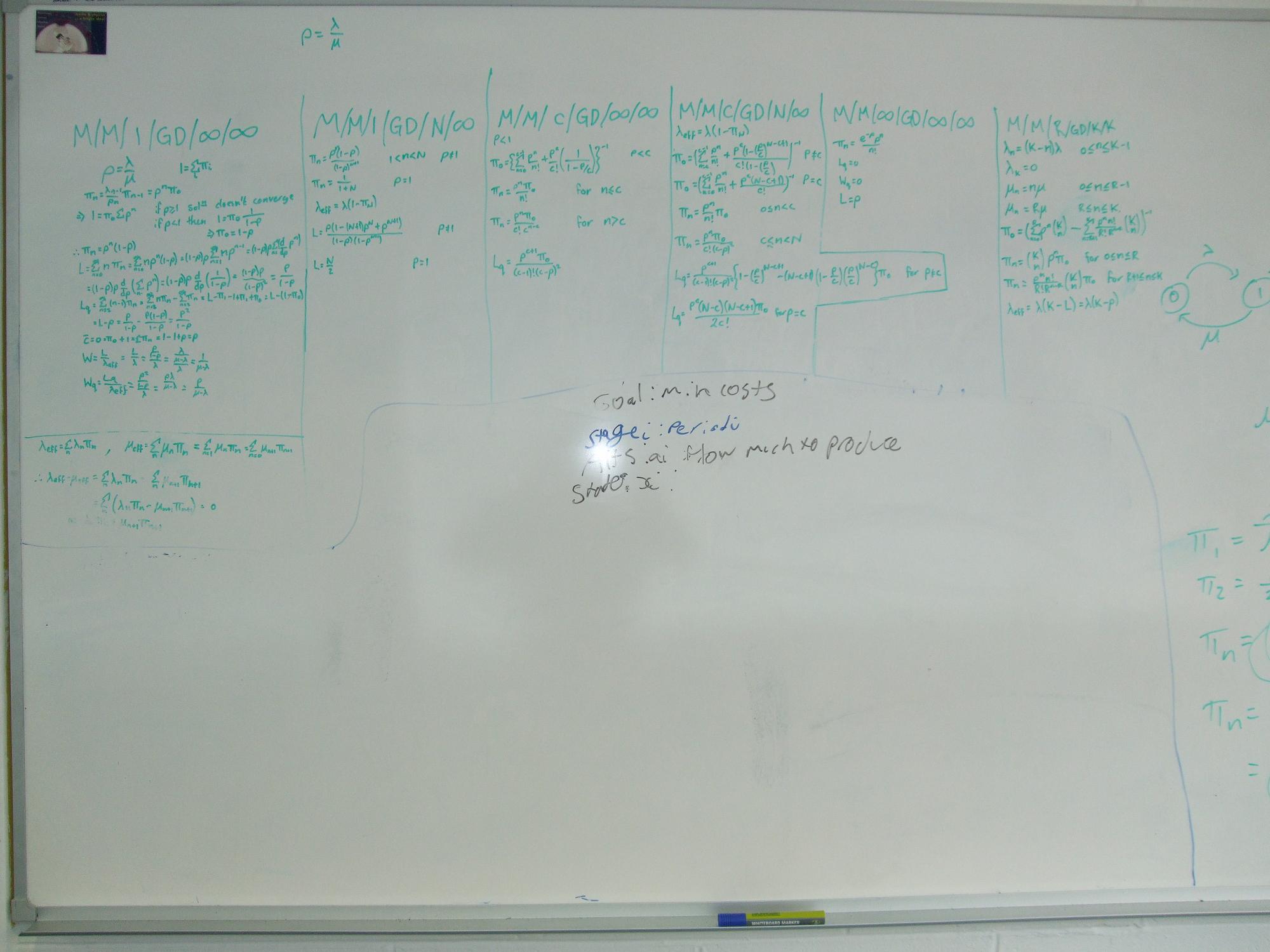
Probability Models:
Operations research is an
interdisciplinary mathematical science that
focuses on the application of advanced
analytical methods to help make better
decisions. Operations Research methods are used
in modelling a wide range of industrial,
environmental, and biological systems of
significance. Its latest technologies use
methods drawn from Probability, Optimization and
Simulation. Operations Research is a
highly
sought-after field of expertise by
industry, which contributes millions of dollars
in benefits and savings each year.
Stochastic Modeling is a research area
within Operations Research that focuses on
developing probabilistic models for real-life
systems having an element of uncertainty. The
work involves constructing useful models,
analyzing them analytically, deriving
mathematical expressions for various important
performance measures, and building efficient
algorithms for their numerical evaluations. Markov
Chains is the most important class of
stochastic models due to their powerful modeling
features, numerical tractability, and
applicability to a wide range of real-life
systems of great engineering or environmental
significance. A Markov Chain, named for Andrey
Markov, is a mathematical system that undergoes
transitions from one state to another, between a
finite or countable number of possible states.
It is a random process characterized as
memoryless, as the next state depends only on
the current state and not on the sequence of
events that preceded it. This specific kind of
"memorylessness" is referred to as the Markov
property.
Markovian-modulated models
are built on the concept of Markov Chains.
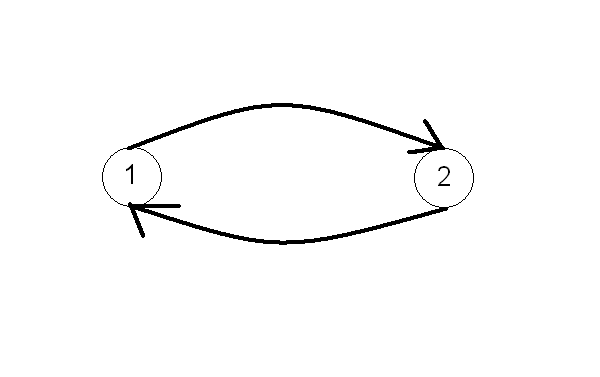
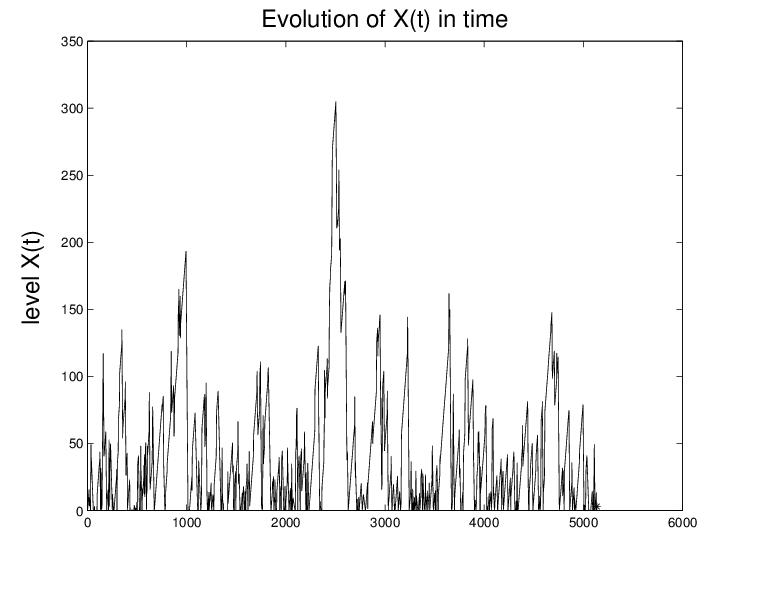
Their state space is two-dimensional and
consists of the phase
variable i(t) and the level
variable X(t). Phase is used to model the
state of some real-life environment, while
level is used to model its performance
measure at time t. The phase changes
according to some underlying Markov Chain.
The rate at which the level changes at time
t depends on the current phase i(t). For
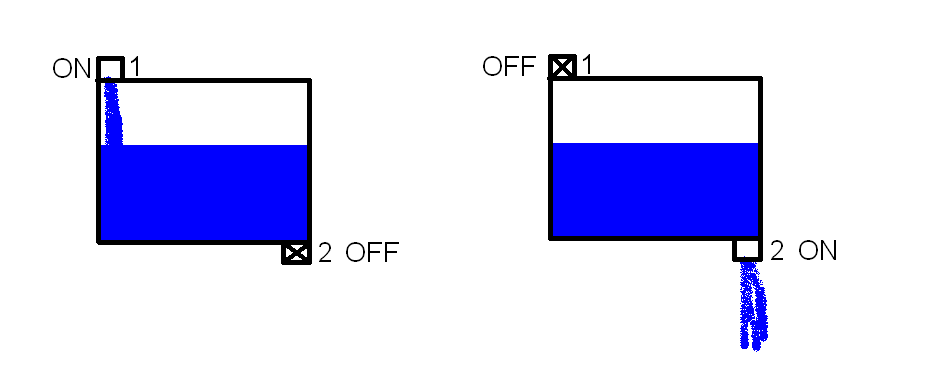
example, in modelling of a
telecommunications buffer, the phase may
represent the operating switch, while the
level may be the amount of data in the
buffer. The rate at which the buffer empties
of fills in, depends on which switch is on.
Selected conference talks:
2020 - AustMS
Meeting - 8-11 December 2020, Special
session: Probability theory and stochastic
processes. my talk
2020 - Phylomania
- The Twelfth Theoretical Phylogenetics Meeting at
UTAS, November 25-27. my talk
2019 - MAM10
- The Tenth International Conference on
Matrix-Analytic Methods in Stochastic Models.
my talk
2017 - AP@Rock
- An International Workshop To Celebrate Phil
Pollett's 60th Birthday, April 17-21, Ayers Rock
Resort. my talk
2013 - ANZAPW
- Australia and New Zealand Applied Probability
Workshop, July 8-11,
Brisbane. my talk
2012 - ANZAPW
- Australia and New Zealand Applied Probability
Workshop, January 23–27, Auckland,
NZ. my
talk
2011 - MAM
7 - Seventh International on Matrix Analytic
Methods in Stochastic Models, June 13–16, New
York, USA. my
talk
Battula, S.K.,
O'Reilly, M.M., Garg, S., Montgomery, J. A
Generic Stochastic Model for Resource
Availability in Fog Computing
Environments. IEEE Transactions on
Parallel and Distributed Systems,
32(4),9253552, pp. 960-974, 2021.
Heydar,
M., O’Reilly, M.M., Trainer, E., (...),
Taylor, P.G., Tirdad, A. A stochastic
model for the patient-bed assignment
problem with random arrivals and
departures. Annals of Operations
Research, Article in Press.
Abera,
A.K., O’Reilly, M.M., Fackrell, M.,
Holland, B.R., Heydar, M. On the decision
support model for the patient admission
scheduling problem with random arrivals
and departures: A solution approach. Stochastic
Models, 36(2), pp. 312-336, 2020.
M.M.
O'Reilly, W. Scheinhardt. Stationary
distributions for a class of
Markov-modulated tandem fluid queues. Stochastic
Models, 33(4), pp. 524-550, 2017.
A. Samuelson,
A. Haigh, M.M. O'Reilly, N.G. Bean. On the
generalized reward generator for stochastic
fluid models: a new equation for Psi. Stochastic
Models, 1-29, 2017.
T.L. Stark,
D.A. Liberles, B.R. Holland, M.M. O'Reilly.
Analysis of a mechanistic Markov model for
gene duplicates evolving under
subfunctionalization. BMC Evolutionary
Biology, 17(38):1-16, 2017.
B.
Margolius, M.M. O'Reilly. The analysis of
cyclic stochastic fluid flows with
time-varying transition rates. Queueing
Systems, 82(1-2):43-73, 2016.
A.
Anees, J. Aryaj, M.M. O'Reilly, T. Gale. A
Relative Density Ratio-Based Framework for
Detection of Land Cover Changes in MODIS
NDVI Time Series. IEEE Journal of
Selected Topics in Applied Earth
Observations and Remote Sensing,
vol.99, pp. 1-13, 2015.
Ashley
Teufel, Jing Zhao, Malgorzata O'Reilly,
Liang Liu, David Liberles. On Mechanistic
Modeling of Gene Content Evolution:
Birth-Death Models and Mechanisms of Gene
Birth and Gene Retention. Computation,
Computational Biology section, special
issue ``Genomes
and Evolution: Computational Approaches'',
2:112-130, 2014.
M.M.
O'Reilly. Multi-stage stochastic fluid
models for congestion control. European
Journal of Operational Research, 238
(2) pp. 514-526, 2014.
N.G.
Bean and M.M. O'Reilly. The Stochastic
Fluid-Fluid Model: A Stochastic Fluid
Model driven by an uncountable-state
process, which is a Stochastic Fluid Model
itself. Stochastic Processes and Their
Applications, 124 (5) pp. 1741–1772,
2014.
M.M.
O'Reilly and Z. Palmowski. Loss rate for
stochastic double fluid models. Performance
Evaluation, 70 (9):593-606, 2013.
N.G.
Bean, M.M. O'Reilly and P.G. Taylor.
Algorithms for the Laplace-Stieltjes
transforms of the first return
probabilities for stochastic fluid flows.
Methodology
and Computing in Applied Probablility,
10 (3): 381-408, 2008.
N.G.
Bean, M.M. O'Reilly and P.G. Taylor.
Hitting probabilities and hitting times
for stochastic fluid flows. Stochastic
Processes and Their Applications
115(9): 1530-1556, 2005.
N.G. Bean, M.M.
O'Reilly and P.G. Taylor. Algorithms for
the first return probabilities for
stochastic fluid flows. Stochastic
Models 21(1): 149-184, 2005.
Theses:
PhD thesis:
"Necessary conditions for the optimal
design of linear consecutive systems",
University of Adelaide, October 2002.
Supervisor: Prof
Charles E.M. Pearce. Also, see Adelaidean
2002.