| Unit
coordinator/lecturer: |
Dr Małgorzata O'Reilly |
Email:
|
Malgorzata.OReilly@utas.edu.au |
| Phone: |
6226 2405 |
Fax:
|
6226 2867 |
| Room number: |
455
|
| Consultation
hours: |
To be announced |
Prerequisites:
Third year mathematics.
Recommended prior knowledge: The knowledge of
basic probability is strongly recommended. KMA305 , which offers a
solid background in probability models, is recommended.
Unit description: This
course is the result of my personal
research interests in stochastic fluid models (SFMs).
SFMs,
inspired by
the engineering problems primarily in high-speed telecommunications
networks,
have seen rapid development in recent years. It has quickly become
evident that
SFMs have tremendous application potential in many other areas, well
beyond
telecommunications. These areas include manufacturing and management,
and
environmental problems, such as coral modelling and water management.
In order to study
and understand SFMs, one first need to become familiar with stochastic
models
such as (discrete-time/continuous-time) Markov Chains and their special
class,
(discrete-time/continuous-time) Quasi-Birth-and-Death-Processes (QBDs).
Also,
one needs to learn about a class of very useful techniques known as
Matrix-Analytic Methods (MAMs).
The aim of this
course is to give you an overview of the concepts that you need to be
familiar
in order to study SFMs, and to give you an introduction to SFMs. You
will
study
the theory with the focus on the physical interpretations. You will
learn about
powerful algorithms that are useful for evaluation of various important
performance measures.
Possible honours
topics: Talk to me about that!
References:
- Marcel F. Neuts, Matrix-Geometric
Solutions
in Stochastic Models
- G. Latouche and V.
Ramaswami, Introduction to Matrix
Analytic Methods in Stochastic
Modeling
- A number of published
papers
Stochastic Fluid Models
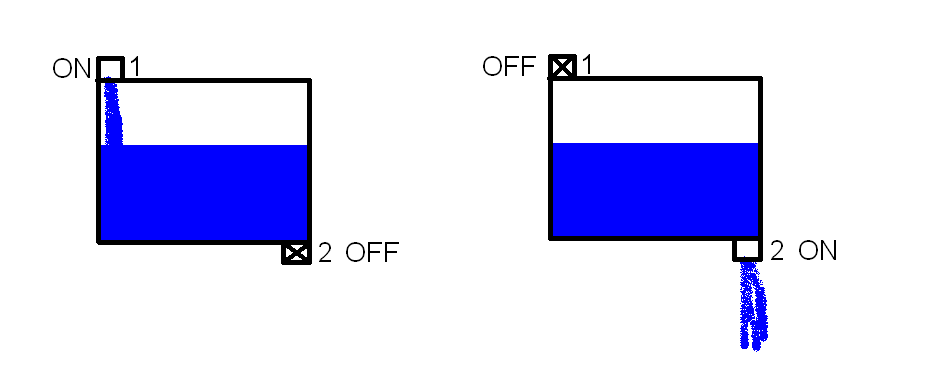
In a Stochastic fluid model, a container of fluid is
filled/emptied
at a rate that depends on the state of an underlying Markov chain. The
state space is two-dimensional and consists of the level
variable (the fluid level in the buffer) and the phase
variable (the state of the
underlying Markov chain).
The
phase variable is often used to describe the state of the environment.
Simple
two-phase examples are on/off mode of a switch in a telecommunications
buffer,
peak/off-peak period in a telephone network, or wet/dry season in
reservoir
modelling. In general, models with any (finite) number of phases are
analyzed,
and so the application potential extends far beyond the simplistic
examples
listed here.
This model has attracted a lot of interest
due to its applicability in the analysis of real-world systems such as,
for example, high-speed communication networks. Very interesting
results for this model have been obtained in the recent five years.
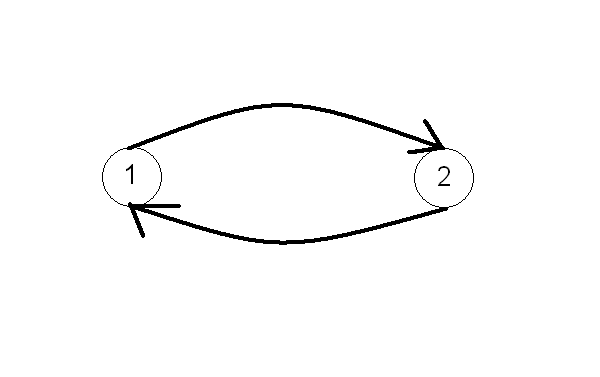
Below is a simple example of a two-phase model (models with any finite
number of phases are studied).